Ultimate Guide to Table Selection for Poker Players
Find soft games, read online/live table metrics, choose seats, and use data-driven rules to raise your poker win rate and cut variance.
Want to boost your poker results? Start with better table selection. The secret to winning more isn’t just about mastering hands or bluffing - it’s about choosing the right games. Table selection means picking tables with less skilled opponents, which can dramatically improve your win rate and reduce variance. Here’s why it matters:
- Skill gap equals profit: Playing against weaker opponents increases your edge.
- Soft tables = higher win rates: Adding just one recreational player can increase your win rate from 0.3 bb/100 to 5.5 bb/100.
- Format matters: Online, look for stats like average pot size and players per flop. Live, observe behaviors like frequent limping or passive play.
The key takeaway? Your table choice can impact your success more than any single hand. Learn how to find soft games, position yourself effectively, and avoid tough tables to maximize your profits.
Guerrilla Poker Training - The Value of Table Selection
sbb-itb-94c8472
Core Principles of Profitable Table Selection
Profitable table selection is all about improving your win rates while keeping variance in check.
Soft vs. Tough Tables: What Makes a Game Worth Playing?
The difference between a soft table and a tough one boils down to the frequency of opponent errors. A soft table is filled with players who make predictable mistakes - calling too much, limping into pots, or misjudging their bet sizes. On the other hand, a tough table is packed with aggressive regulars who know their way around 3-bets, excel at playing in position, and rarely give away chips without a fight.
"You could be the greatest farmer in the world, but you won't get very far trying to grow crops in the desert. Planting seeds in fertile soil isn't strategy – it's the basics of being a good farmer." - Greg Walker
The key to profit lies in exploiting mistakes. If you're up against skilled regulars, your edge shrinks - or even disappears - no matter how strong your technical game is.
Spotting table softness requires a mix of sharp observation and using the right metrics to guide your decisions.
Key Metrics for Evaluating a Table
Whether you're playing online or live, certain indicators can help you decide if a table is worth sitting at.
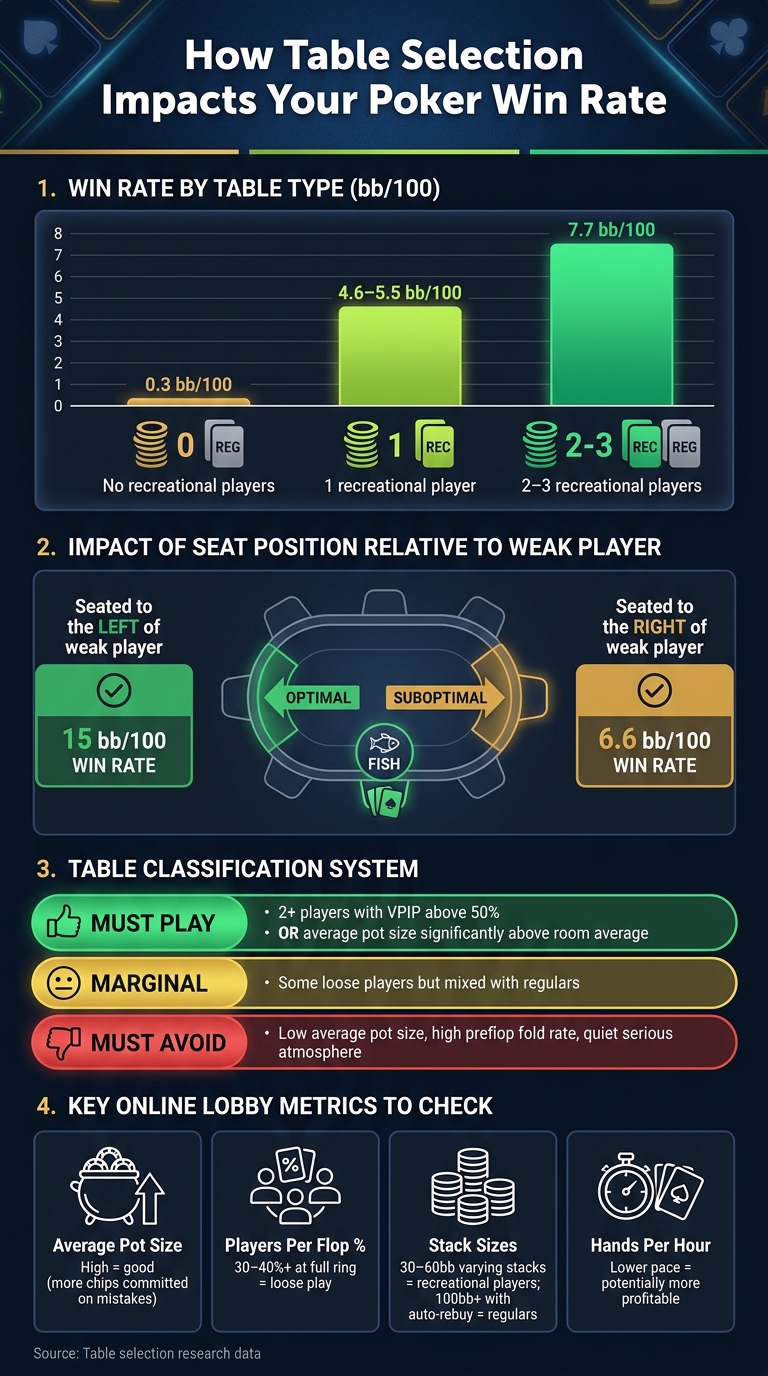
Online, the poker lobby provides helpful stats. Pay close attention to two key numbers: average pot size and players per flop percentage. A high average pot size means players are putting more chips into the pot - often due to mistakes. Meanwhile, a high players-per-flop percentage (30–40% or more at a full-ring table) signals loose play, which is exactly what you want to see.
However, if the flop percentage is high but the average pot size is low, you're likely looking at tight-passive play. In these cases, prioritize the average pot size over the flop percentage for better decision-making.
| Metric | High Value Means | Low Value Means |
|---|---|---|
| Average Pot Size | Players committing more chips behind mistakes | Conservative, cautious play |
| Players per Flop % | Loose starting hand requirements | Tight, disciplined ranges |
| Hands per Hour | Reg-heavy or fast-fold game | Slower-paced, potentially more profitable |
| Stack Sizes | 100bb+ with auto-rebuy = regulars | 30bb–60bb, varying stacks = recreational players |
Live, you won't have the luxury of lobby stats, so you'll need to rely on what you see at the table. Look for players limping into pots, calling raises with weak hands, or showing inconsistent bet sizing. A table where chips are moving around frequently is often a sign of more action - and more profit opportunities.
These metrics and observations will help you assess player skill levels and position yourself effectively.
How to Spot Weak and Strong Players
One of the most important skills in poker is identifying the weakest player at the table.
Recreational players often give themselves away through certain habits. They limp into pots, over-call, and rarely size their bets consistently. Once the flop hits, they tend to check down hands, avoid bluffing, and fail to adjust their hand ranges based on position.
"A soft seat doesn't just mean a table where players make occasional mistakes; it implies a systemic lack of understanding of fundamental poker principles." - Bence Mitykó, Author, SoMuchPoker
In contrast, strong regulars are much more deliberate. They raise and 3-bet aggressively, adapt their ranges depending on position, and apply calculated pressure with consistent, purposeful bet sizing.
Online, you can quickly gauge player tendencies by checking HUD stats like VPIP (Voluntarily Put Money In Pot) and PFR (Pre-Flop Raise). A large gap between these numbers - such as a VPIP of 40% and a PFR of 8% - is a classic sign of a loose-passive recreational player.
Seat Selection and Positioning at the Table
After identifying a soft table, the next critical step is picking the best seat. Just like table selection, choosing where to sit is an ongoing process that requires you to adapt as players come and go. Your position relative to specific opponents can significantly affect your success.
How to Position Yourself Against Aggressive and Weak Players
The strategy here is simple: sit to the left of weaker players and to the right of aggressive ones.
Why? When a recreational player is on your right, you act after them. This gives you the advantage of seeing their actions first, enabling you to isolate them with raises, steal their blinds more effectively, and make better decisions at every stage of the hand. Greg Walker emphasizes this point:
"Try and sit to their left if you can, as this will give you a positional advantage."
On the other hand, aggressive regulars are easier to handle when they're sitting to your right. If they’re on your left, their 3-bets and aggressive plays can disrupt your strategy before you even act. By positioning yourself to their left, you get to observe their moves and adjust your play accordingly.
For calling stations - players who rarely fold and almost never bluff - your focus should be on value betting. Having position on these players allows you to maximize profits, making it one of the most impactful moves you can make at any table.
Keep an eye on these dynamics throughout the game. If the balance shifts, it might be time to change seats.
When and How to Change Seats or Tables
Adapting your seat as the game evolves is crucial to maintaining your edge. A seat that was advantageous an hour ago might no longer be profitable as players leave or new ones join. Stay alert to these changes.
In a live game, watch for open seats during your session. If a weak player sits to your right or a better position opens near the table’s softest player, request a seat change immediately. Before committing to the move, take a moment to observe the table dynamics - stack sizes and player tendencies can reveal whether the new seat truly offers an edge.
Online, this process is more streamlined. Many platforms let you search for specific players by screen name, allowing you to join their table directly. Keeping a list of known recreational players can help you proactively find soft games rather than waiting for one to appear in the lobby.
Sometimes, the smartest move is knowing when to leave altogether. If the weaker players at your table cash out and are replaced by regulars, your edge can disappear quickly - even if you’re ahead for the session. As Bence Mitykó puts it:
"The best strategy for a tough table is often simply to leave and find a softer one."
Resist the temptation to let ego keep you at a tough table. Successful players view seat and table changes as strategic adjustments, not signs of weakness.
Avoiding Tough Games and Keeping Your Ego in Check
After fine-tuning your seat selection strategy, the next step is learning how to steer clear of unprofitable tables and keeping your emotions in check.
Red Flags That Signal a Tough Table
Spotting a tough table is just as important as finding a profitable one. Certain stats can give you a heads-up. For example, a low average pot size and fewer players seeing the flop often indicate tight, disciplined play. A high preflop fold rate is another warning sign, as it suggests value is only being extracted from premium hands, leaving little room for profit.
Beyond the numbers, take note of the table's vibe. If the atmosphere feels overly serious - quiet players, deliberate decisions, and a lack of casual banter - you’re likely surrounded by seasoned regulars. A table like this is more about grinding than fun, which might not align with your goal of maximizing profits.
Choosing the Right Time and Venue to Play
Picking the right tables isn’t just about analyzing stats - it also depends on when and where you play. Recreational players are more likely to show up during evenings and weekends, while midday games on weekdays tend to attract regulars who take poker seriously.
The venue plays a big role, too. Poker rooms attached to casinos or sportsbooks often attract casual gamblers wandering in from other games. On the other hand, standalone poker rooms without a casino floor nearby usually have a tighter, more competitive player pool.
If you’re struggling to find softer games at your current stakes, don’t hesitate to drop down a level. A $1/$2 table with four recreational players can be far more profitable than a $2/$5 game filled with regulars. Sometimes, the lower stakes offer better opportunities to build your bankroll.
Overcoming Emotional Bias in Table Selection
While stats and positioning can give you a strategic edge, emotional discipline is what truly solidifies your approach. Letting emotions guide your decisions can quickly lead to costly mistakes.
One common trap is the sunk cost fallacy - the idea that you should stay at a table simply because you’ve already invested time or money. As mindset expert Karina Karagaeva explains:
"The sunk cost fallacy is most dangerous when we have invested a lot of time, money, energy, or emotions in something. This investment becomes a reason to carry on, even if we are dealing with a lost cause."
Another trap is the gambler’s fallacy - the belief that a losing streak means you’re "due" for a win. In reality, every hand is independent, and a tough table won’t magically become easier just because you’ve had bad luck.
When you’re tempted to stay at a table that isn’t working out, ask yourself these three questions:
- What’s the logical reason for staying? Focus on facts, not feelings.
- What does the data say? Look at stack sizes, player tendencies, and pot sizes.
- Am I staying to win, or just to break even? These are very different motivations.
Walking away from a bad game isn’t a sign of defeat - it’s one of the smartest and most disciplined decisions you can make as a poker player.
Building a Data-Driven Table Selection System
How Table Selection Impacts Your Poker Win Rate
Turning instincts into a structured, repeatable strategy can elevate your table selection game. A data-driven approach ensures consistency, especially when emotions might cloud your judgment.
Setting Clear Rules for Which Tables to Play
Top players don’t leave table selection to chance - they establish clear benchmarks before they sit down. Think of it as a checklist: if a table meets your criteria, you play; if not, you move on.
A practical way to begin is by categorizing tables into three types: must-play, marginal, and must-avoid. For instance, a must-play table might feature at least two players with a VPIP (voluntarily put money in pot) above 50% or an average pot size significantly higher than the room’s average. Research backs this up: win rates jump from around 0.3 bb/100 at tables without recreational players to 4.6–5.5 bb/100 with one weaker player, and up to 7.7 bb/100 when two or three are present.
When comparing soft tables, prioritize average pot size over the players-per-flop percentage. A higher average pot size often signals opponents committing more chips with weaker hands, giving you a greater advantage.
"If you want to win money, you should play as many hands as you can against the worst players you can find." - Greg Walker, Poker Strategist
Establishing these rules creates a reliable framework for evaluating table choices.
Tracking and Reviewing Your Table Selection Decisions
Once you’ve set your rules, tracking your decisions is the next step. Keeping a session log can uncover patterns and areas for improvement. Record key details like average pot size, player types, and your position relative to the weakest player. For example, the "Distance to Fish" metric - whether you’re seated to the left or right of a weak player - can have a major impact. Sitting to their left can lead to win rates of 15 bb/100, compared to just 6.6 bb/100 when positioned to their right. Recognizing these trends can help you refine your strategy over time.
Additionally, note why you left a table. Did the recreational player bust out? Did the game tighten up? These observations can reveal nuances that hand history alone might not highlight.
Using Pokerbase to Sharpen Your Table Selection
Manual tracking can be time-consuming, but tools like Pokerbase simplify the process. With features like session tracking and advanced statistics, Pokerbase helps you log not just your results but also the context behind them. You can track game types, stakes, and performance trends across sessions, making it easier to build and refine a data-driven table selection system with minimal effort.
Conclusion
How Good Table Selection Supports Long-Term Results
Picking the right table is one of the smartest ways to protect your bankroll and improve your performance over time. It’s not just about increasing your win rate - it’s also about avoiding the mental strain of constantly battling highly skilled opponents.
Bart Hanson, Owner and Lead Pro at Crush Live Poker, explains it perfectly:
"Focus on finding the table with the worst average winrate between all players, instead of focusing on just finding the table with the worst player who has the biggest stack."
This shift in perspective - from targeting a single weak player to assessing the overall table dynamics - sets apart consistent winners from those who rely on streaks of luck.
Treating Table Selection as a Skill You Can Improve
Mastering table selection isn’t just a one-time decision - it’s a skill that can be sharpened over time. Like any other skill, it improves with practice and thoughtful analysis. The most successful players treat each session as a learning opportunity, tracking what made a game favorable or challenging and adjusting their approach accordingly.
Using tools like Pokerbase can make this process more structured. By logging session details, tracking trends across stakes and game types, and identifying patterns, you can move beyond relying on memory alone. Over time, this creates a feedback loop that continually enhances your decision-making process. This kind of disciplined tracking aligns perfectly with the data-driven strategies discussed earlier, emphasizing why table selection is such a critical element of long-term success.
The best players don’t just excel at playing - they excel at choosing where to play. Make table selection a cornerstone of your strategy, and the results will follow.
FAQs
How long should I stay at a table before switching?
When it comes to deciding how long to stay at a poker table, there’s no universal rule. What really matters is evaluating the table’s profitability early on. Pay attention to factors like the presence of weaker players or opponents with a low win rate. If the table doesn’t seem profitable or starts getting tougher, don’t hesitate to move on.
The key is to focus on early evaluation and continuous reassessment rather than sticking to a predetermined timeframe. This approach helps you make the most of your opportunities and maximize your winnings.
What’s the fastest way to spot a weak player in live poker?
The fastest way to spot a less experienced player in live poker is to look for patterns of poor decision-making and inconsistency. Some telltale signs include playing an excessive number of hands, making predictable errors, showing hesitation during key moments, and using ineffective bet sizes. By keeping an eye out for these behaviors, you can identify weaker opponents and select tables that give you a better edge.
Which stats matter most for table selection in online poker?
When it comes to online poker, table selection stats can make a big difference in your results. Two key metrics to focus on are:
- Hands per hour rate: A higher rate often suggests a passive table with less aggressive players, which could mean more opportunities to capitalize on mistakes.
- Player tendencies: Understanding whether players are aggressive or passive helps you spot tables with weaker opponents and avoid tougher competition.
By paying attention to these details, you can position yourself at tables where profitability is more likely.