How to Create Clear Poker Staking Agreements
Essential terms for fair poker staking deals: roles, scope, profit splits, makeup, reporting, and dispute clauses.
Poker staking agreements are essential for ensuring transparency and fairness between backers (investors) and players (competitors). Without clear terms, disputes over profit splits, makeup debt, or game scope can arise, leading to costly misunderstandings. Here’s what every staking agreement should include:
- Roles and Responsibilities: Clearly define who the backer and player are, including their financial and gameplay obligations.
- Scope of Play: Specify the games, stakes, and platforms covered to avoid unauthorized participation.
- Duration: Outline whether the deal is for a single event, a series, or a long-term arrangement (e.g., 12–24 months).
- Financial Terms: Detail buy-ins, expenses, profit splits (e.g., 50/50 or 60/40), and how losses (makeup) are handled.
- Transparency: Require accurate session tracking, receipts, and updates to maintain trust.
- Legal Protections: Use written agreements with clear payment methods, governing laws, and dispute resolution terms.
A well-documented agreement prevents confusion, protects both parties, and ensures a professional partnership. Tools like Pokerbase can simplify tracking and reporting, making it easier to stay aligned. Always prioritize clarity and transparency to avoid future conflicts.
How To Stake Poker Players
Key Elements of a Staking Agreement
A staking agreement doesn't need to be lengthy, but it must cover the essentials. Missing even a single key detail - like the games involved or the duration of the agreement - can lead to misunderstandings down the line. Here's what every staking agreement should include.
Defining the Parties and Their Roles
Start by listing the full legal names and roles of everyone involved. In staking, the Backer is the investor, and the Player (sometimes called the "horse" or "stakee") is the competitor. This distinction is crucial both legally and practically, as the roles define the responsibilities of each party within the agreement.
If there are multiple backers sharing the investment, the agreement must clearly outline each backer's ownership percentage and how payouts will be divided. This clarity is especially important in high-stakes situations, where disputes over distribution can arise if the player performs well in a major event.
The next step is to define the games and limits that apply to the agreement.
Scope of Games and Limits
The agreement should specify exactly what the player is allowed to play. This includes naming the game formats, such as No-Limit Hold'em (NLHE), Pot-Limit Omaha (PLO), or Mixed Games, as well as the types of tournaments covered, like MTTs (Multi-Table Tournaments), SNGs (Sit-and-Gos), or cash games.
Be clear about buy-in limits. A defined buy-in cap or Average Buy-In (ABI) helps prevent the player from entering higher-stakes games without the backer's approval. Attorney Maurice "Mac" VerStandig emphasizes the importance of precision:
"Be concrete on terms. The amount being put up by the backer should be unambiguous and in the form of a plain number."
The agreement should also list the platforms or venues where the player is allowed to compete, such as GGPoker, PokerStars, or live events like the WSOP. If the player wants to participate in games outside the agreement's scope, an explicit approval process should be outlined.
Duration and Coverage
The length of the staking deal is a key factor that influences all other terms. Staking agreements typically fall into one of three categories: single event, series package (like a WSOP schedule), or long-term arrangements lasting 12–24 months.
The table below highlights common durations and scopes for different types of agreements:
| Agreement Type | Typical Duration | Common Scope |
|---|---|---|
| One-Time / Single Event | One day or event | A specific tournament or cash session |
| Series / Package | Duration of a series | A bundle of scheduled events with a fixed budget |
| Long-Term | 12–24 months | Ongoing MTT or cash game grind |
Any geographic or platform restrictions should also be explicitly stated. For example, if the deal only covers live play in Las Vegas or is limited to a specific online platform, this needs to be detailed in the agreement. Similarly, some long-term agreements include volume requirements, such as a minimum number of hands or hours per month, to ensure the backer's investment is actively being used.
Financial Terms and Profit Sharing
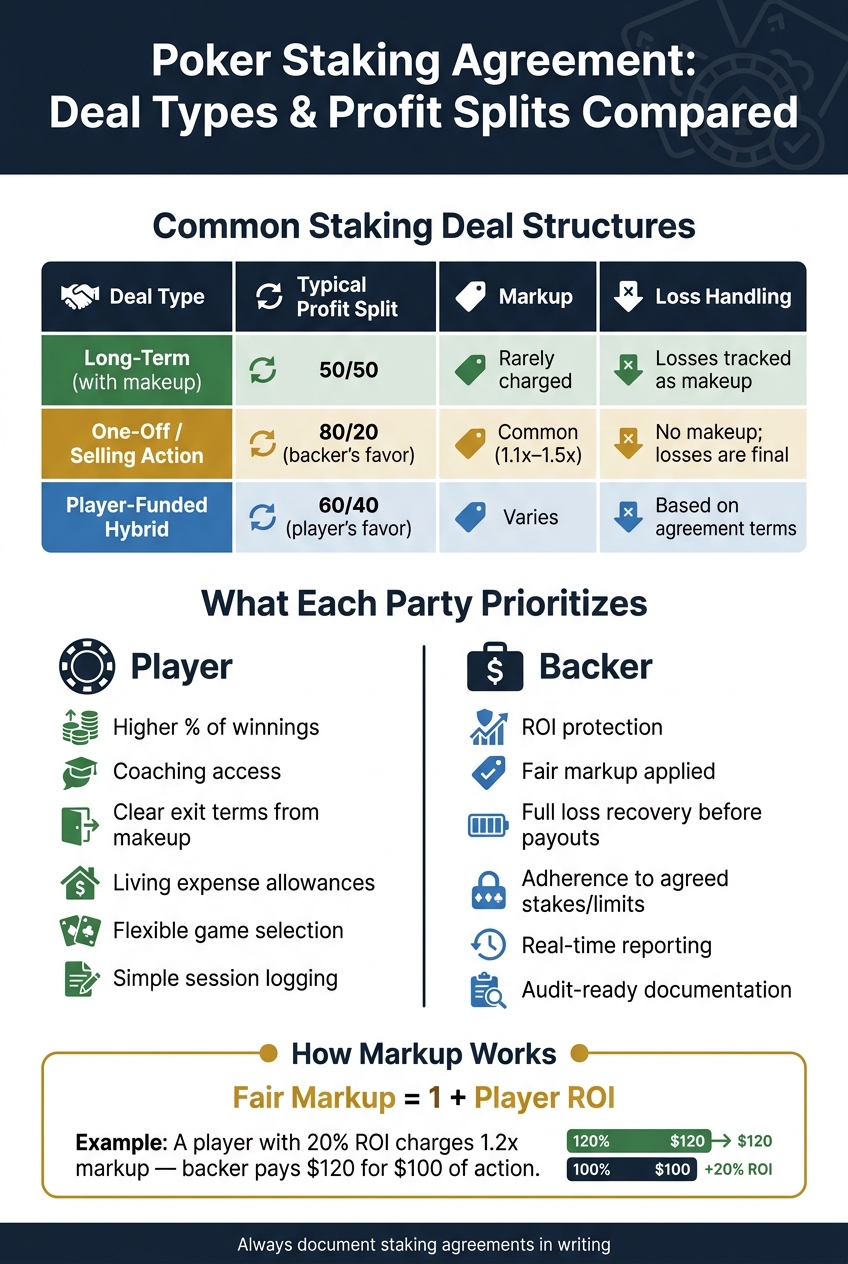
Poker Staking Agreement: Player vs. Backer Priorities & Deal Types
Once the scope and timeline of a staking deal are established, the financial terms become critical. Clarity here ensures both parties are protected.
Funding and Expenses
It's essential to outline the backer's total funding, any buy-in caps, and a detailed list of covered events. Non-playing costs, such as travel, lodging, rake, and tips, should be assigned to one party or excluded entirely. Setting a cap on expenses can help prevent returns from being eaten away.
Maurice "Mac" VerStandig highlights the importance of precise expense language:
"Be clear whether or not a backer is entitled to be reimbursed the stake before any equity split is in place, or if their seed funds are factored into the formula."
The agreement should also address whether the player can add their own funds to the stake or play in outside events independently. Once costs are defined, the next step is to establish clear profit-sharing terms.
Profit Splits and Makeup
Profit splits often vary based on the level of risk and contributions. A standard arrangement is a 50/50 split, where the backer covers all buy-ins, and profits are divided equally after the stake is returned. For higher-risk events, a 70/30 split favoring the backer is common, while a 60/40 split in the player's favor might apply if the player contributes their own funds.
In long-term agreements, losses are typically tracked as "makeup" - a cumulative balance the player must repay through future winnings before profits are shared. As professional poker agent Lorenzo explains:
"Makeup ensures that deals are not as risky to backers, and can soak up player payouts to an extreme extent. It alters motives as well and may invoke mental pressure."
For one-off deals, players with proven performance often charge a markup - a premium over the buy-in's face value. A common guideline is that fair markup equals 1 plus the player's ROI. For instance, a player with a 20% ROI might charge a 1.2 markup, meaning a backer pays $120 for $100 of action.
| Deal Type | Typical Split | Markup | Loss Handling |
|---|---|---|---|
| Long-term (with makeup) | 50/50 | Rarely charged | Losses tracked as makeup |
| One-off / Selling Action | 80/20 (backer's favor) | Common (1.1–1.5x) | No makeup; losses are final |
| Player-funded hybrid | 60/40 (player's favor) | Varies | Based on agreement terms |
Refunds and Cancellations
Unused buy-in funds should be returned to the backer immediately. The agreement should also address situations like cancellations, illness, or no-shows, specifying whether funds will be refunded or rolled over to a substitute event. For long-term deals, players cannot exit with an outstanding makeup balance. If the backer cancels, the makeup balance is typically forgiven.
sbb-itb-94c8472
Transparency and Reporting Requirements
Transparency is the backbone of trust in staking agreements. It ensures that everyone involved understands their responsibilities and obligations. Without clear and consistent communication, even the most well-structured staking deal can quickly fall apart.
Player Conduct Expectations
A staking agreement should leave no room for ambiguity when it comes to professional behavior. Players are expected to stick to the agreed stakes and game types, maintain proper bankroll management, and fulfill any volume commitments - whether that's logging a specific number of hours each month or participating in a set tournament schedule. Taking risks by playing at higher stakes without the backer's explicit consent is strictly off-limits.
Equally important is full transparency. If a player sells portions of their action to multiple backers, all parties must be informed. Overselling - where the total percentage of action sold exceeds 100% - creates payout scenarios that simply can't be honored. As Poker World Champion and author Chris Wallace warns:
"A backing deal gone sour can be very frustrating and can cost you future backing deals because backers don't want to get involved with a player that could be a problem."
This level of discipline lays the groundwork for accurate session tracking and accountability.
Tracking Results and Proof
Every session needs verifiable documentation, including payout tickets, screenshots, and hand histories.
| Tracking Category | Required Data Points |
|---|---|
| Session Data | Date, game type, buy-in, location |
| Financials | Cash-out result, markup, percentage of action sold |
| Accountability | Running makeup balance, rebuys, notes |
| Proof | Screenshots, scanned receipts, hand logs |
Semi-pro poker player Roger Marquez emphasizes the importance of this transparency:
"Good communication between a stakee and the backer is absolutely vital to ensuring the success of any type of poker staking agreement."
To simplify these tasks, using dedicated tools can make a big difference.
Using Pokerbase for Accountability
Manual tracking can be tedious and prone to errors. Pokerbase offers a streamlined solution with features designed to make reporting easier. For example, the Document Scanner allows players to instantly capture receipts and attach them to the appropriate session, ensuring thorough and organized recordkeeping. The Live Feed feature lets players provide real-time updates to their backers, keeping everyone informed with structured, up-to-date information.
When it’s time to reconcile, Pokerbase’s Accounting PDF Export generates a detailed summary of session history and financials, simplifying reviews and even tax reporting. With over 30,000 users and a stellar 4.9/5 rating on the Apple App Store, Pokerbase is a practical tool to help players and backers stay aligned.
Legal Protections and Dispute Resolution
Having strong legal protections in place is crucial to building trust and ensuring that your staking agreement is enforceable. Once you've set up tracking and reporting systems, the next step is to make sure the agreement itself can stand up to scrutiny if disputes arise.
Drafting and Signing the Agreement
Relying on a verbal or handshake deal is risky and often unenforceable. Maurice "Mac" VerStandig, Managing Partner of the VerStandig Law Firm, emphasizes this point:
"A handshake deal is of ultimately only the most fleeting evidentiary value, and the era of a person's handshake being their word... has largely passed us by."
At the very least, create a clear email chain where both parties explicitly agree to the terms. For higher-stakes arrangements, a notarized written contract is a much stronger option. Keep the language straightforward - avoid poker-specific jargon like markup equations - and make sure the terms are easy for anyone to understand. Thanks to the U.S. ESIGN Act, digital signatures are legally binding, offering a simple and effective way to formalize agreements.
After documenting the agreement, it's equally important to establish how funds will be exchanged to prevent misunderstandings down the line.
Payment Methods and Jurisdiction
Specify the exact payment methods to be used - whether it's bank transfer, check, or another agreed-upon method - and confirm all amounts in U.S. dollars (USD). Include a governing law clause that identifies the state whose laws will apply and where any legal disputes will be handled. Without this clause, disagreements could devolve into arguments over which court has jurisdiction. It's also wise to address secondary income, such as bonuses, rakeback, and tips, in the agreement. Leaving these details unaddressed could lead to unnecessary friction later.
Resolving Disputes and Ending the Agreement
Once you've settled the execution and payment terms, it's time to outline how disputes will be handled and how the agreement can be terminated. Mediation or arbitration is often faster and less expensive than litigation, so consider building a preference for one of these methods into the contract. This ensures both parties know what to expect if conflicts arise.
Termination terms are equally important. A common practice is that a player cannot leave while in makeup without repaying the outstanding balance. Walking away in such a scenario would unfairly leave the backer to absorb losses they never agreed to shoulder alone. On the other hand, backers typically have the right to end the arrangement at any time. However, agreements should never include clauses that permanently restrict a player from playing independently or seeking other backers. Courts have been known to strike down such terms, labeling them as "indentured gambling servitude". A well-defined exit process, including a final accounting period and a clear makeup settlement plan, ensures a smooth and professional conclusion for both parties.
| Termination Scenario | Standard Practice |
|---|---|
| Player exits while in makeup | Must repay outstanding deficit before leaving |
| Backer ends the deal early | Can terminate at any time |
| Mutual agreement to close | Final accounting completed; net balance settled in full |
| Overly restrictive exit clauses | Risk being voided by courts as "indentured servitude" |
Conclusion and Key Takeaways
A staking agreement relies on a solid, trust-based relationship between the player and the backer. It’s important to clearly outline key details such as the games allowed, stakes, venues, financial terms (commonly a 50/50 split, though top-tier players may negotiate a 60/40 split), makeup rules, expenses, and the duration of the deal (ranging from a single event to 12–24 months). Always ensure the agreement is documented, even if it’s just through a detailed email exchange.
Transparency is non-negotiable. Backers need clear proof of activity, including receipts, session logs, and timely updates. Digital tools can make this process much smoother. For example, Pokerbase allows players to scan receipts directly, keep backers updated in real time using the Online Rail feature, and generate professional PDF accounting reports for easy audits.
"Pokerbase is the best poker bankroll tracker - user-friendly and comprehensive. With its intuitive interface, I can effortlessly monitor my wins, losses, and overall performance."
– Aliaksandr Shylko, Professional Poker Player
The table below highlights the priorities for both players and backers when setting up a staking deal:
| Component | Player's Priority | Backer's Priority |
|---|---|---|
| Profit Split | A higher percentage of winnings; coaching access | ROI protection; fair markup |
| Makeup | Clear exit terms; allowances for living expenses | Full recovery of losses before payouts |
| Scope | Flexibility in game selection | Adherence to agreed stakes and limits |
| Reporting | Simple logging (e.g., via Pokerbase) | Real-time updates; audit-ready documentation |
These priorities reflect the balance of interests needed for a successful partnership.
"A vaguely defined agreement can lead to disputes that might necessitate legal intervention."
FAQs
What should I do if the staking deal terms change mid-package?
If the terms of a package change midway, make sure to document those updates in writing right away to prevent any misunderstandings. Ideally, your initial agreement should already outline how renegotiations will be handled. Avoid depending on verbal agreements - always ensure any changes are agreed upon by both parties and confirmed in writing, such as through email. Keeping communication open is essential, and tools like Pokerbase can assist in tracking changes and ensuring clarity in your staking arrangement.
How can we prevent overselling and track who owns what percent?
To avoid overselling, it's crucial to check a player's total staking commitments before making an investment. Always secure written agreements that clearly detail percentages and terms before transferring any money. Use a transparent system to keep track of all buy-ins, cash-outs, and payments - tools like Pokerbase simplify this process by automating staking management and tracking. Additionally, collect funds upfront to solidify agreements and steer clear of disputes or unexpected last-minute changes.
When should we use a lawyer versus a simple written agreement?
For smaller deals, a straightforward written agreement works well. It should clearly cover essential terms like profit split, markup, makeup, payout timing, and communication expectations. However, when dealing with larger investments or situations where fund security is critical - such as involving multiple backers - it's wise to consult a lawyer. A professionally drafted formal agreement offers better protection and helps reduce the chances of disputes.