Pregame Mental Prep Checklist for Poker Players
A 6-step pregame routine to sharpen focus, manage tilt, set limits, and visualize disciplined decisions before poker sessions.
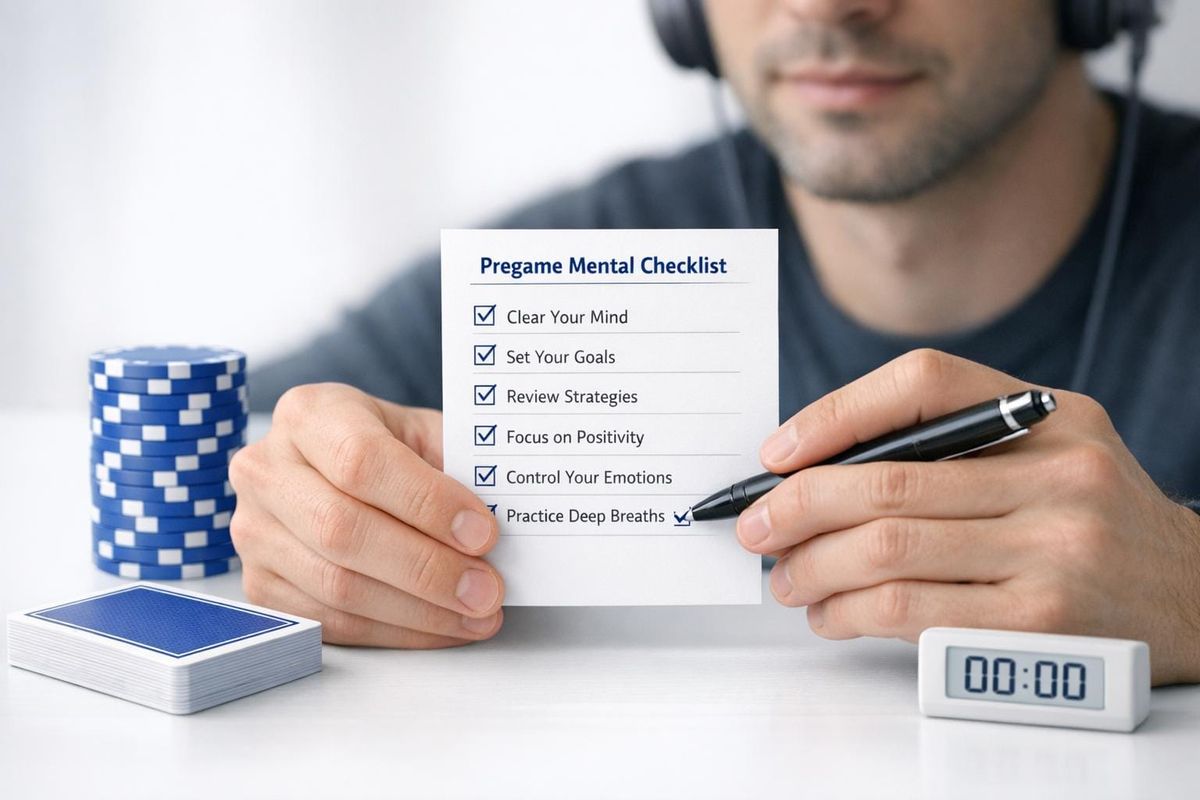
Your mental state directly impacts your poker performance. A clear, focused mind can help you make better decisions, while distractions or stress can derail even the most skilled players. This is why creating a pregame mental prep routine is essential. Here's what you need to know:
- Why It Matters: Your emotional state influences decision-making by affecting brain function. A pregame routine helps shift focus to poker and builds long-term habits for consistency.
- Core Steps:
- Set a Goal: Focus on improving specific skills, not chasing financial outcomes.
- Check Your State: Use a 1–10 scale to assess readiness. Address stress, fatigue, or hunger before playing.
- Optimize Your Environment: Eliminate distractions, silence your phone, and prepare your space for focus.
- Use Breathing and Mindfulness: Simple exercises like box breathing or body scans sharpen focus and calm emotions.
- Visualize Key Scenarios: Mentally rehearse disciplined decisions and prepare for tilt triggers.
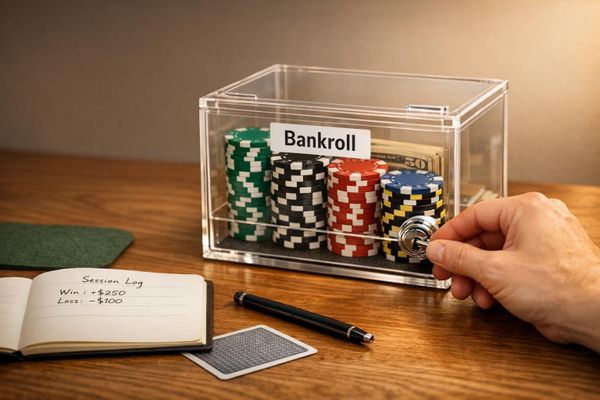
- Define Limits: Set stop-loss rules, session durations, and bankroll guidelines to protect your mindset and results.
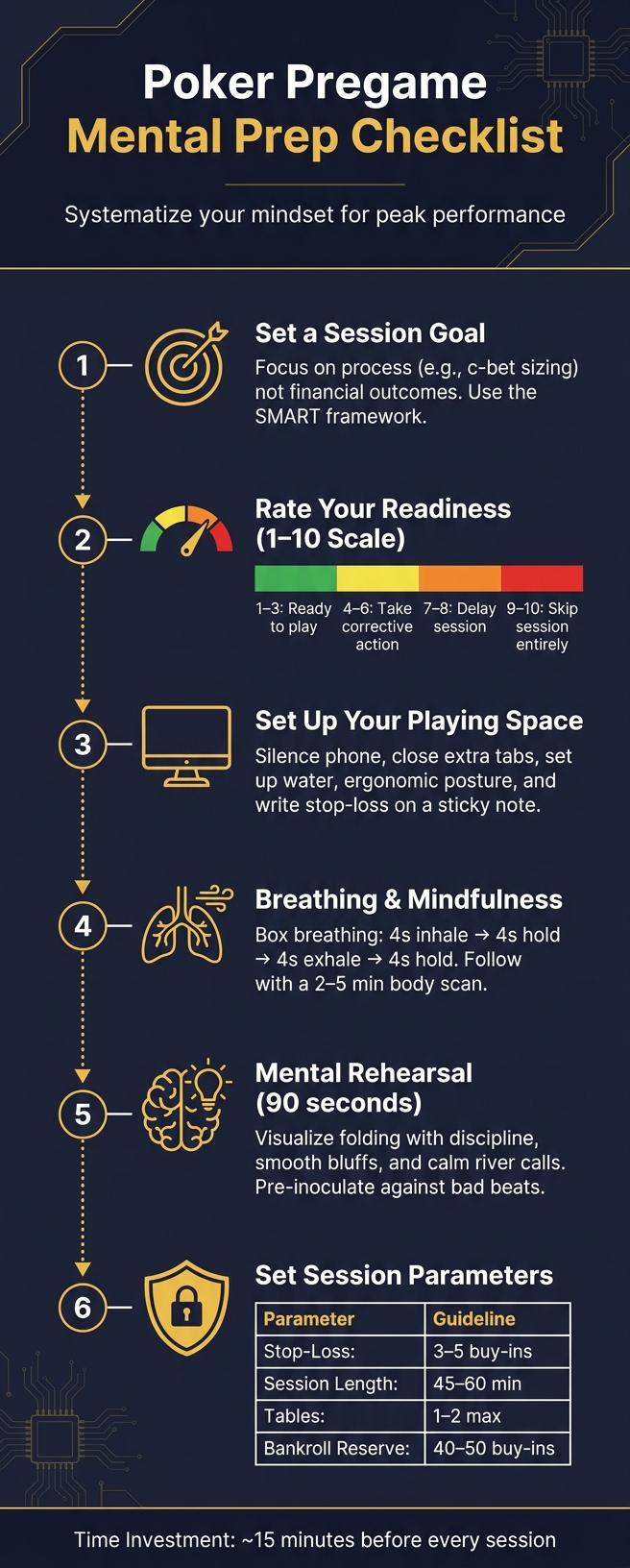
Poker Pregame Mental Prep Routine: 6-Step Checklist
Mastering The Fundamentals: Mental Game Strategy
sbb-itb-94c8472
Building Your Core Mindset Before a Session
Before diving into a session, set aside 15 minutes to shift your mindset from everyday concerns to a more strategic, focused approach.
Define Your Session Purpose
Instead of asking, "How much do I want to win?" try reframing the question to, "Why am I playing today, and what specific skill do I want to improve?"
Focusing on process-oriented goals is much more effective than chasing financial outcomes. For instance, setting a goal like "I will concentrate on c-bet sizing on connected boards" gives you a clear, actionable focus. On the other hand, a goal like "I want to make $200" leaves you vulnerable to variance. Even a skilled player running at 5 bb/100 will experience losing sessions about 40% of the time.
To make your goal more actionable, use the SMART framework: keep it Specific, Measurable, Achievable, Relevant, and Time-bound. Tools like Pokerbase can help you log and review your session goals, ensuring you stay on track.
Once your goal is set, take a moment to evaluate your internal readiness to execute it effectively.
Check Your Emotional and Physical State
Your body often reveals your readiness before your mind catches up. Signs like a clenched jaw, shallow breathing, or restless legs can indicate that you're not in the right state for making high-quality decisions.
Before each session, use a simple 1–10 scale to rate your state:
| Zone | Rating | What It Means | What to Do |
|---|---|---|---|
| Green | 1–3 | Calm, focused, and ready to perform at your best | Start your session |
| Yellow | 4–6 | Feeling mildly stressed or tired | Take corrective action, like a short walk or drinking water |
| Orange | 7–8 | Experiencing significant emotional disturbance | Delay your session |
| Red | 9–10 | Overwhelmed and reactive | Skip playing entirely for the day |
If your rating is above 5, pause and identify the root cause - it could be stress from work, lack of sleep, or even hunger. Address these issues before starting. Interestingly, adrenaline spikes that lead to impulsive decisions often subside within 60 seconds if you pause and focus on your breathing. A quick glass of water or a 5-minute walk can also help bring you back into the Green zone.
Once your emotional and physical state is steady, it's time to optimize your environment for success.
Set Up Your Playing Environment
With your goal defined and your internal state in check, the next step is to remove external distractions. Your environment can either support or sabotage your focus. Notifications, open browser tabs, or background noise can all chip away at the focus needed for strategic decision-making.
"Fifty percent of my poker success comes from mental clarity. My mindset is my edge." - Maria Ho, Professional Poker Player
Here’s a comparison of an optimal setup versus one riddled with distractions:
| Feature | Prepared Environment | Distracting Environment |
|---|---|---|
| Phone | Silenced, face-down, or placed in another room | On the desk with active notifications |
| Software | Only the poker client and essential tools are open | Multiple tabs, social media, or videos running |
| Physical setup | Water nearby, ergonomic posture, and proper lighting | Slouching, dehydrated, or surrounded by noise |
| Cognitive load | Fully focused on strategic decisions | Scattered attention and autopilot decision-making |
A simple but powerful tip: write your stop-loss rule on a sticky note and place it near your monitor. For example, "I stop if I lose 3 buy-ins." Externalizing this commitment makes it far more likely you'll stick to it than if it remains just a mental note.
Focus and Centering Techniques
Now that your environment is set and your emotions are in check, it’s time to get your mind into strategic mode. This means engaging your prefrontal cortex fully before diving into the game.
Breathing Routines
To sharpen your focus, start with simple breathing exercises. One of the most effective methods is box breathing: inhale for 4 seconds, hold for 4 seconds, exhale for 4 seconds, hold for 4 seconds, and repeat. If you're carrying more tension than usual, try the 4-7-8 method - inhale for 4 seconds, hold for 7 seconds, and exhale for 8 seconds. This approach actively slows your heart rate and helps calm your nervous system.
Controlled breathing doesn’t just relax you - it brings your prefrontal cortex back into action. This shift helps reduce impulsive decisions and promotes more thoughtful, deliberate play. Even a quick three-breath reset before sitting down can make a noticeable difference.
Mindfulness Practice
Once your breathing is steady, a brief mindfulness exercise can deepen your focus. A 2–5 minute body scan is a great way to clear mental distractions. Start at your forehead and work your way down to your feet, paying attention to areas of tension. For example, you might notice a clenched jaw, tight shoulders, or shallow breathing - all signs that you’re not fully present yet. Consciously relax each tense area before moving on.
"Mindfulness in poker isn't some mystical routine; it's the practice of paying full attention to the present moment without judgment." - Optimus Poker
Psychology research shows that building a consistent pre-session routine like this can turn it into an automatic habit in about 60 days. The payoff? A sharper mental edge that continues to grow with minimal extra effort.
Getting Into a Neutral Performance State
The goal isn’t to get hyped up. It’s to reach a neutral state - calm, clear, and detached from the session’s results. Here’s a reality check: even winning players lose money in about 40% of their sessions. Losses aren’t a sign of failure; they’re simply part of the game’s mathematical structure.
To reinforce this mindset, adopt a simple internal mantra: "I made correct decisions today," rather than "I won today." As ThinkGTO explains:
"Confidence in poker should be rooted in process, not results."
Achieving a neutral performance state means you’ll approach the game the same way, whether you’re up three buy-ins or down two. This level-headed mindset is a crucial step in your pregame preparation, ensuring that you stay consistent and strategic no matter what.
Visualization and Mental Rehearsal
Once your focus is sharp and your emotions are steady, it's time to prepare your mind for the session ahead. Think of this as a mental warm-up - you're training your brain to respond thoughtfully, rather than reacting impulsively under pressure.
Visualize Disciplined Decision-Making
Take about 90 seconds before each session to run through three key scenarios: folding with discipline, bluffing smoothly, and making a calm river call. The goal isn’t to imagine winning but to visualize yourself making solid decisions. For instance, picture facing a tough three-bet, pausing to assess, and folding without frustration.
You can take this a step further with pre-session inoculation: spend two minutes imagining a bad beat where you lose despite holding the best hand. Feel the wave of frustration briefly, then picture yourself taking three slow, deep breaths, acknowledging the emotion, and refocusing on the next hand with full composure.
Once you've visualized disciplined plays, shift your focus to recognizing and managing tilt triggers during the session.
Identify and Plan for Tilt Triggers
Tilt often creeps up gradually rather than arriving all at once. To stay ahead of it, use a simple tool like the 1–10 emotional scale, rating yourself every 20 minutes during a session. This helps you catch emotional shifts early.
| Zone | Rating | What It Feels Like | Your Action |
|---|---|---|---|
| 🟢 Green | 1–3 | Calm, focused, sharp | Stay the course |
| 🟡 Yellow | 4–6 | Mild frustration, slight edge | Slow down decisions by 3–5 seconds and take deep breaths |
| 🟠 Orange | 7–8 | Impaired thinking, reactive | Take a 5–10 minute break |
| 🔴 Red | 9–10 | Full tilt, emotional override | End the session immediately |
Be mindful of physical signals like a clenched jaw, tight shoulders, or a flush of heat in your face. These can be early signs of tilt. Also, notice if you start rushing decisions or replaying a bad hand in your head. Use this awareness, along with the tilt-trigger table, to adjust your behavior before emotions take over.
Affirmations and Identity Statements
To strengthen your mental preparation, use affirmations that reinforce a process-driven mindset. These affirmations should focus on decision-making quality rather than outcomes. They help you stay grounded, even during challenging sessions.
Here's a comparison of helpful affirmations versus harmful self-talk:
| Helpful Affirmation (Process-Focused) | Harmful Self-Talk (Result-Focused) | Why It Matters |
|---|---|---|
| "I made mathematically sound decisions today." | "I need to win $500 this session." | Builds confidence that withstands downswings |
| "I am a disciplined player who follows my stop-loss." | "I am better than these players; I shouldn't be losing." | Reduces entitlement tilt and protects your bankroll |
| "I focus on the current hand, not the last one." | "I have to get even before I log off." | Prevents revenge tilt from spiraling |
| "Variance is a feature of the game I play." | "I am the unluckiest player in the world." | Helps neutralize the emotional sting of bad beats |
A single-line intention can serve as your mental anchor. For example, "Default to math, protect energy, trust the long term" is short, memorable, and effective for guiding you through tough moments.
Strategic Alignment and Session Parameters
Lock in your game plan with clear goals and strict boundaries. These steps take the mental preparation you’ve built through focus and visualization and turn it into actionable strategies.
Review Study Notes and Pick Focus Areas
Start by reviewing your recent study materials - things like solver outputs, range charts, or board-texture heuristics - for about 5 minutes. From there, choose one or two specific areas to concentrate on during your session. For example, you might focus on c-bet sizing for connected boards or refining your 3-bet ranges from the blinds. Keeping your focus narrow ensures you’re working on something meaningful without overwhelming yourself.
Next, spend 5–8 minutes on training drills or GTO puzzles to get your brain into a strategic mindset. Think of it as a warm-up for your decision-making muscles. You can also quickly review 2–3 hands from a previous session where you struggled to find the right play. This step keeps your technical skills sharp and bridges the gap between preparation and execution.
Recall a Recent Mistake and Plan a Fix
Pinpoint one specific mistake you made in a recent session - something you know was an error in judgment or execution. Then, define a clear correction plan. For instance, if you’ve been calling river raises too loosely on flush-completing boards, your fix could be: “I will fold to river raises on flush-completing boards unless I have a flush.” It’s direct and actionable.
Take 60 seconds to mentally rehearse the corrected response. Picture the situation and visualize yourself making the right decision. This quick mental exercise helps you recognize similar spots during play and prevents you from falling back into old habits under pressure.
Set Session Limits and Risk Controls
Establishing firm limits before you play is one of the most effective habits you can develop in poker. As ThinkGTO explains:
"A single red-zone session can erase weeks or months of disciplined, profitable play. This rule is non-negotiable."
Here’s a breakdown of recommended parameters for professional-level play. These aren’t arbitrary - they’re designed to protect your bankroll and maintain emotional stability:
| Parameter | Recommended Limit | Primary Benefit |
|---|---|---|
| Stop-Loss | 3–5 buy-ins (cash games) | Prevents revenge tilt and shields your bankroll from emotional spirals |
| Session Duration | 45–60 minutes | Reduces mental fatigue and keeps your decision-making sharp |
| Table Count | 1–2 tables | Promotes deliberate practice and avoids autopilot tendencies |
| Bankroll Reserve | 40–50 buy-ins | Provides emotional security to weather natural variance |
Write these limits down on a sticky note before you start playing. This simple action helps ensure you stick to your rules. Over time, you can track how well you’re adhering to your parameters using tools like Pokerbase. This app lets you log session details, monitor your bankroll, and identify patterns in your performance and discipline.
Using and Improving the Checklist Over Time
Your pregame checklist should grow and change as your game evolves. A quick online session has different needs compared to a 10-hour live tournament. Similarly, beginners will need more detailed steps than experienced players. Keeping your checklist aligned with your goals and strategy ensures it remains effective.
Checklist Versions for Different Session Types
Not all poker sessions are created equal, so your checklist should adapt to the session type and length. Here's a quick guide:
| Session Type | Time Investment | Core Focus Areas |
|---|---|---|
| Quick Online | ~5 minutes | Silence phone, close extra tabs, run one 5-minute GTO drill |
| Standard Cash Game | ~15 minutes | Review goals, technical warm-up, confirm stop-loss |
| Tournament / Live Event | 20–30 minutes | Check physical health, set observation goals, confirm buy-in limit, prep for endurance |
For online sessions, distractions like notifications and open tabs can be your biggest enemy. Eliminate them before you start. During live sessions, use breaks to observe opponents instead of scrolling on your phone. And for tournaments, make sure you're physically ready for the long hours ahead - endurance can make or break your performance.
Track and Refine Your Routine with Pokerbase
Completing your checklist is just the beginning. To truly improve, you need to track its effectiveness. Tools like Pokerbase make this easy. After each session, log your mental readiness and any key observations. Over time, patterns will emerge, showing whether skipping certain steps leads to more tilt or poor decisions.
Track details like how well you stick to your stop-loss, whether you followed your pre-session strategy, and any emotional triggers you noticed. Research shows that consistent mental game training can increase ROI by up to 40% within six months. That’s a huge boost, and it starts with consistent tracking.
Use Pokerbase’s session notes to jot down 2–3 hands where you felt unsure and highlight moments when your emotions shifted. After a few weeks, review your notes to spot recurring issues. Updating your checklist based on these insights is just as important as practicing breathing exercises or visualizations. Your own data - not theory - should guide your next steps.
"Winning is a byproduct of process, not obsession." - Jared Tendler
Conclusion: Gaining a Mental Edge Through Routine
Many players dedicate countless hours to studying hand histories and mastering GTO solvers, but they often neglect the one thing that connects all that preparation to their actual gameplay: their mental state. As ThinkGTO aptly puts it: "Technical skill determines your ceiling. Mental game determines how close you actually play to that ceiling on any given day."
The gap between your maximum potential and your performance at the table is where a reliable pregame routine comes into play. A structured warm-up helps shift your mindset from the chaos of everyday life into a focused, strategic frame of mind. It ensures you conserve your mental energy for the decisions that truly count. Without this preparation, you risk draining your cognitive resources before the game even begins.
Over time, sticking to a routine gives you a compounding advantage. It not only sharpens your decision-making but also enhances how you track and analyze your sessions. This is where tools like Pokerbase become invaluable. Beyond simply logging hands, Pokerbase allows you to record your mental state, emotional readiness, and adherence to your pregame checklist, offering insights that go far beyond theory.
"Fifty percent of my poker success comes from mental clarity. My mindset is my edge." - Maria Ho
Your pregame checklist serves as the foundation for achieving and maintaining that mental clarity. But its effectiveness depends entirely on your commitment to using it. Every item on your checklist is designed to help you gain and protect your mental edge. Start with small, manageable steps, stay consistent, and use your results to fine-tune your routine over time.
FAQs
What’s the fastest pre-session routine I can do in 5 minutes?
The quickest way to get mentally prepped in just 5 minutes is by following a simple routine that sharpens focus and builds confidence:
- Self-Assessment (1 min): Take a moment to gauge your mental state. Are you feeling rested and focused? If not, acknowledge it and adjust your approach.
- Focus Exercise (1-2 mins): Engage in deep breathing or a quick meditation to clear distractions and center your mind.
- Visualization (1-2 mins): Imagine yourself performing at your best. This mental rehearsal can help boost your confidence and set a positive tone.
- Set Intentions (1 min): Decide on specific goals for your session, like maintaining focus or avoiding emotional reactions.
This quick routine helps you step into the game with a clear mind and a strong sense of purpose.
How do I know if I’m too tilted to start playing?
If you notice physical signs like a racing heart, shallow breathing, or feeling emotionally agitated, it might be a good idea to take a break before playing. Mentally, impulsive decisions, anger, or the urge to "teach someone a lesson" can be red flags. If you find yourself feeling reactive or blaming bad luck, it's a clear signal to pause and reset before diving back into your session.
What should I track after each session to improve my mental game?
Tracking your emotional responses, triggers, and focus levels after each session can make a big difference in improving your mental game. Pay close attention to moments of tilt, emotional reactions, and how you managed them. By spotting patterns, you’ll be better equipped to develop strategies for control, boost your confidence, and maintain focus - even when the pressure is on. These habits are essential for staying consistent in your performance.