How Solver Misuse Hurts Your Poker Game
Why copying poker solver outputs backfires — use realistic inputs, simplify strategies, and exploit opponent tendencies.

Using poker solvers can improve your game - if used correctly. But misuse can backfire, leading to confusion and poor decision-making at the table.
Here’s the problem: many players blindly copy solver outputs without understanding the reasoning behind them. This robotic approach doesn’t work in live games, where opponents rarely play optimally. Missteps like using unrealistic inputs, ignoring opponent tendencies, or overcomplicating strategies can quietly harm your performance.
Key Takeaways:
- Solvers are tools for study, not a playbook to mimic.
- Misusing solvers includes blindly copying outputs, using bad inputs, or failing to adjust for real-life opponents.
- Focus on learning principles, not memorizing frequencies.
- Use realistic, population-based inputs and simplify strategies for live play.
- Build a feedback loop: play → analyze with solvers → apply insights → repeat.
I Used Poker Solvers Completely Wrong
Key Ways Solver Misuse Hurts Your Game
Solvers can be incredibly helpful tools, but their value depends on how well you interpret and apply their insights. Misusing them - even in subtle ways - can quietly undermine your poker game. Let’s look at some of the most common habits that reduce a solver's practical effectiveness.
Blindly Copying Solver Frequencies
One of the biggest mistakes new solver users make is memorizing outputs without understanding the reasoning behind them. The truth is, solver frequencies are only meaningful when you consider the full context of a balanced range. In real-world play, you’re rarely working with perfectly balanced ranges over thousands of hands.
"A solver can make a play look precise even when the player does not understand why it exists. That is dangerous." - BluffingMonkeys
If you simply copy solver frequencies without grasping the logic, you’re likely to freeze up at the table. This can lead to second-guessing and indecision, which severely hampers your ability to make quick, confident choices in real time.
Using Unrealistic Inputs
Another major pitfall is feeding solvers with unrealistic inputs. For example, if you assume your opponent opens 25% of hands from the button when the actual rate is closer to 40%, your results will be way off.
"If you tell the solver the button opens 25% when the population opens 40%, every downstream output is wrong." - ThinkGTO
Stack depths also play a critical role. A solution designed for 100 big blinds won’t translate well to a 50 big blind scenario. And if you ignore rake - especially in lower-stakes games where it’s a significant factor - you’ll end up with strategies that aren’t profitable in practice. It’s simple: bad inputs mean bad outputs.
Applying Solver Lines Without Adjustments
Solver outputs assume your opponents are playing close to optimally, but real-life players rarely do. At lower stakes, for instance, many opponents overfold to three-bets, underfold on the river, or avoid bluffing on certain board textures altogether. If you blindly follow a solver-recommended bluffing frequency against someone who calls with any pair, you’re just burning money.
Solvers are meant to provide a starting point. If you don’t adjust for your opponent’s tendencies, you’re setting yourself up for costly mistakes.
Studying Spots in Isolation
Another common error is studying individual spots without connecting them to earlier decisions. Every action in poker is part of a larger sequence. If you study a river spot in isolation, for example, you might miss that the solver’s river check-back assumes you bet that same hand on the turn. Without understanding how earlier decisions shape later ones, your range composition will differ from what the solver assumes.
Disconnected study leads to unbalanced play. This lack of context can cause your strategy to collapse under pressure.
Trying to Execute Overly Complex Strategies
Solvers often recommend mixed strategies - where the same hand is played differently at specific frequencies. While these strategies are theoretically optimal, they’re also incredibly difficult to execute without extensive practice and a deep understanding of your ranges.
The problem arises when players try to implement these advanced strategies at the table before mastering the basics. Mistakes pile up quickly, and overcomplicating your approach can lead to inconsistent results. Complexity without mastery only creates more problems.
How to Use Solvers More Effectively
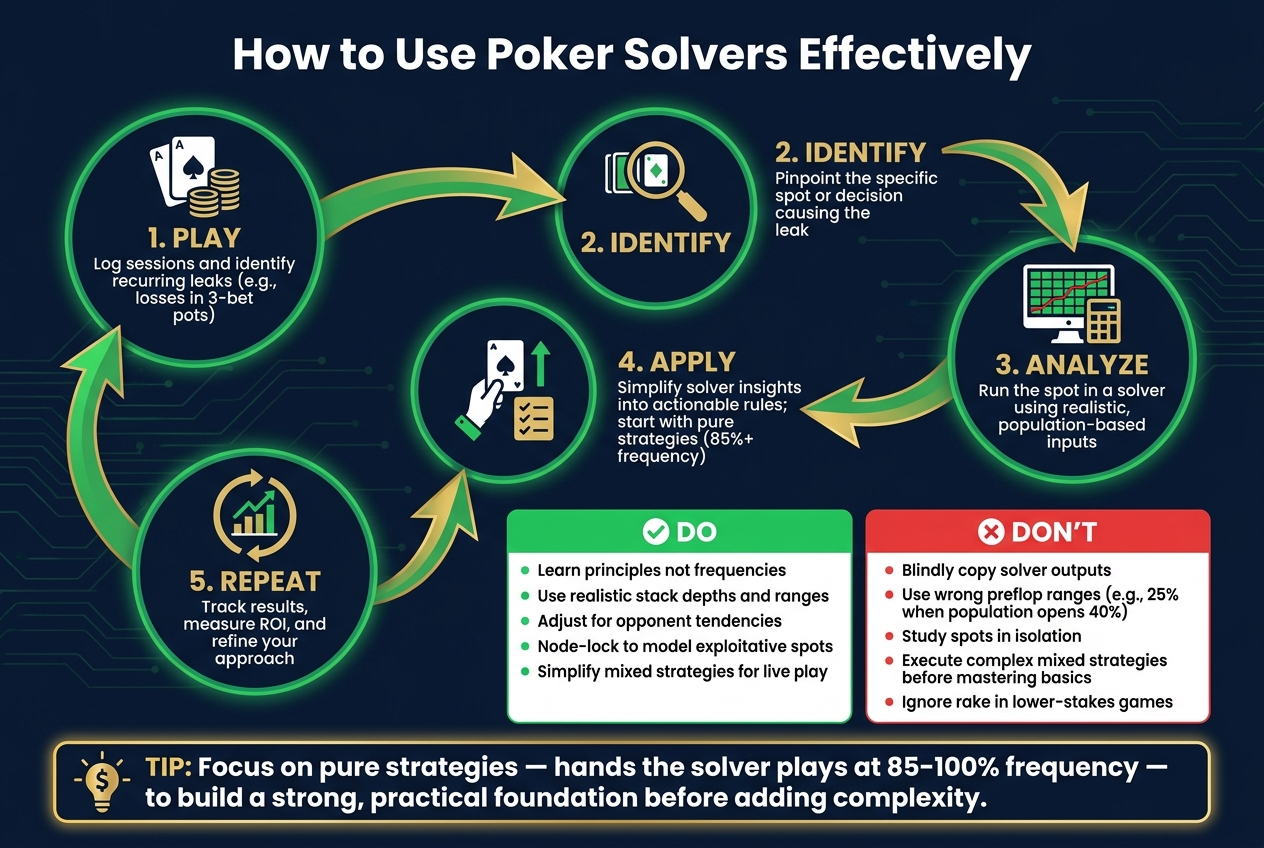
How to Use Poker Solvers Effectively: A Closed-Loop Study System
Learn Principles, Not Frequencies
Instead of memorizing specific solver outputs for individual hands, focus on grasping the reasoning behind those decisions. For example, don’t just ask, “What does the solver do with A♠J♥ on this board?” Instead, ask, “What is the solver teaching me about this board as a whole?” By understanding broader concepts - like when a solver bets 70% of its range - you can recognize that this is a board where betting is often the optimal strategy. This insight is far more useful during live play than knowing the frequency of a single hand.
A good starting point is to focus on pure strategies - hands the solver plays with a frequency of 85% or higher. These "always" or "never" plays highlight the core strategic elements, such as range advantage, nut advantage, and board texture, without the distraction of marginal decisions. Uri Peleg, Lead Coach at Upswing Poker, explains:
"What should I do on the river with my hand? is really just a subset of the bigger question: How do I play rivers in general?"
This mindset helps you build a more practical and flexible approach to solver study.
Use Realistic, Population-Based Inputs
Solvers are only as good as the data you feed them. If your solver assumes opponents open 25% of hands from the button but, in reality, they open 40%, the outputs will be skewed. To get meaningful results, align your solver settings with what you actually observe at your stakes - this includes stack sizes, bet sizing tendencies, and preflop ranges.
Node locking is a great tool for refining solver inputs. For instance, if you know an opponent rarely folds to a continuation bet, you can lock that behavior into the solver and re-solve the situation. This allows you to see how the optimal strategy shifts from a Game Theory Optimal (GTO) approach to an exploitative one.
"GTO strategy is your baseline; node locking shows you how to deviate for profit against specific opponent types." - ThinkGTO
By tailoring your inputs, you can bridge the gap between theoretical play and the real-world tendencies of your opponents.
Start Simple and Build Complexity Over Time
When a solver suggests a mix like 52% bet and 48% check, it often means the EV difference between the two actions is minimal. In these cases, you can simplify by choosing one action and committing to it consistently. This approach reduces mental strain and helps you maintain focus during play. Instead of obsessing over complex randomization, prioritize mastering fundamental strategies - like a straightforward continuation betting plan.
To gradually increase complexity, try using a focus cycle. Spend 2–3 weeks on a specific topic, such as c-betting in position on dry boards. In the first week, study solver outputs; in the second, apply what you’ve learned during play; and in the third, review your performance and refine your approach. Then move on to the next topic.
Add Exploitative Adjustments on Top of Solver Baselines
While solvers provide a solid theoretical foundation, you can maximize your edge by identifying and exploiting opponent tendencies. Start with the GTO baseline, then adjust based on how your opponents deviate from optimal play.
"The process is simple: examine the GTO-recommended strategy, find how the population differs from it, then design adjustments to maximize your EV." - Peter Clarke, Author and Coach, Carrot Corner
For instance, if you notice that players in your pool tend to underfold on the river, you can bluff less and value-bet more aggressively than the solver suggests. These adjustments can significantly boost your profitability.
Build a Closed-Loop Study System
To turn solver study into real improvement, create a feedback loop: play → identify a leak → analyze the spot with a solver → apply the insights at the table → repeat. Spending at least half your study time actively drilling specific situations - rather than passively reviewing outputs - helps you bridge the gap between theory and execution.
"Solvers don't play poker. You do. Use them to sharpen your mind, not replace it." - Try-Poker Editorial
This iterative process ensures that your study translates into practical skills, making you a better player over time.
sbb-itb-94c8472
How Pokerbase Supports Better Solver-Based Study
A dependable data feed is the backbone of effective, closed-loop study. Pokerbase bridges the gap between your live session outcomes and solver studies, highlighting key areas that need attention. Its features integrate smoothly into your study routine, amplifying the benefits discussed earlier.
Track Performance and Identify Study Priorities
Pokerbase automatically logs your live and online poker sessions, replacing the chaos of scattered spreadsheets with a centralized performance database. Its Advanced Statistics and performance filters allow you to dissect your results by game type, stakes, or location, helping you uncover patterns in your winrate. For instance, if the data shows repeated losses in 3-bet pots at $2/$5, it’s a clear indicator to revisit your solver and focus on improving that specific scenario.
"The data will tell you whether you've been studying or just feeling like you've been studying." - PokerToolsGuide
Mark Hands for Solver Review
Reconstructing hands accurately is critical, and relying solely on memory can lead to missed details like stack sizes or bet amounts. Pokerbase’s Hand Recorder lets you log hands in real time. You can also add detailed notes, such as marking an opponent as a "calling station", which provides vital context for later solver analysis using tools like node locking. Before diving into solver work, the built-in replayer ensures you can review and reconstruct the action with precision.
"Pokerbase is the best poker bankroll tracker - user-friendly and comprehensive. With its intuitive interface, I can effortlessly monitor my wins, losses, and overall performance." - Aliaksandr Shylko, Professional Poker Player with over $5.2 million in earnings
Evaluate Bankroll Changes and ROI
Beyond solver refinements, it’s crucial to track the financial outcomes of your adjustments. Pokerbase helps you monitor your hourly rates, ROI, and overall bankroll trends, ensuring you can measure the real-world impact of your solver-based strategies. For players with backers, its staking management tools add transparency, showing whether shifts in strategy are delivering results across different formats and stakes. By setting metrics like winrate at six-month intervals, vague aspirations turn into measurable, data-backed achievements.
Conclusion: Using Solvers the Right Way
To get the most out of solvers, it’s essential to combine their insights with a solid understanding of strategy. Solvers don’t dictate every move - they highlight patterns and principles that can guide your decision-making. The key is to use this information as a tool for learning, not as a rigid playbook.
Top players don’t just memorize solver outputs; they extract the underlying strategic ideas. Focus on the core strategies - those used 85–100% of the time - and distill them into simple, actionable guidelines. From there, adapt based on your opponents’ tendencies at the table to make the most of exploitative opportunities.
The quality of your inputs and the focus of your study sessions directly impact the value you get from solvers. Short, targeted practice sessions are far more effective for building intuition than long, unfocused ones. Success comes from combining accurate data with disciplined, feedback-driven study. By staying context-aware and maintaining a structured approach, you’ll turn solver insights into meaningful improvements in your game.
FAQs
How do I turn solver outputs into simple rules I can use live?
Instead of trying to memorize frequencies, focus on grasping the logic behind solver recommendations. This approach helps you make better decisions without getting bogged down in details.
One way to simplify your strategy is by identifying pure actions and rounding off mixed strategies. Small deviations from solver outputs typically have minimal impact on your expected value, so don't stress over perfection.
Another tip? Study similar board textures to spot patterns. For example, you might notice it’s better to bet more often on boards that favor your range. These patterns can help you develop quick heuristics for live play.
After each session, take a moment to reflect. Write down 2–3 specific takeaways you can apply in future games. Tools like Pokerbase are great for keeping track of these insights and staying organized.
What solver inputs matter most to match my stakes and player pool?
When working with solvers, a few inputs stand out as crucial for ensuring accurate and realistic outputs:
- Starting Ranges: These should align closely with how players in your pool actually play. If the ranges don't reflect their opening or continuation tendencies, the solver's outputs won't be reliable.
- Bet-Sizing Tree: Simplicity is key here. Stick to a few realistic bet sizes per street rather than overwhelming the solver with too many options.
- Effective Stack Size: Make sure this matches the stack depths you typically encounter, whether it's 50bb, 100bb, or another common depth.
Rather than getting lost in the details of specific hands, focus on identifying high-frequency actions and patterns. This approach will help you extract the most useful insights.
When should I node-lock and play exploitatively instead of GTO?
Node-locking and playing exploitatively work best when you’ve identified clear patterns in an opponent’s behavior that stray far from Game Theory Optimal (GTO) play. While GTO is designed to be unexploitable, it’s not always the most profitable strategy against players with obvious weaknesses, such as consistently over-folding or under-bluffing.
Use node-locking during post-session analysis to fine-tune your strategies and explore how adjustments could impact outcomes. In live games, exploit these tendencies carefully - if your opponents catch on and adjust, your predictability could become a liability.