Poker Session Checklist: Track Every Detail
Pre-, during, and post-session checklist to track bankroll, log hands/receipts, note opponent behavior and emotions, analyze performance.
If you're not tracking your poker sessions, you're missing out on improving your game and managing your bankroll effectively. Here's the bottom line: tracking helps you understand your performance, spot leaks in your strategy, and make better decisions at the table.
Key Takeaways:
- Before Playing: Set clear bankroll limits, establish session goals, and prepare mentally by eliminating distractions.
- During Play: Log every buy-in, cash-out, and key hand details in real-time. Note opponent behaviors and track your emotional state.
- After Playing: Review financial results, analyze saved hands, and write down lessons learned to refine your strategy.
Using tools like Pokerbase simplifies this process by offering session logging, hand tracking, and performance metrics in one app. Whether you're a casual player or a pro, consistent tracking turns raw data into actionable insights for long-term success.
Before You Play: Pre-Session Checklist
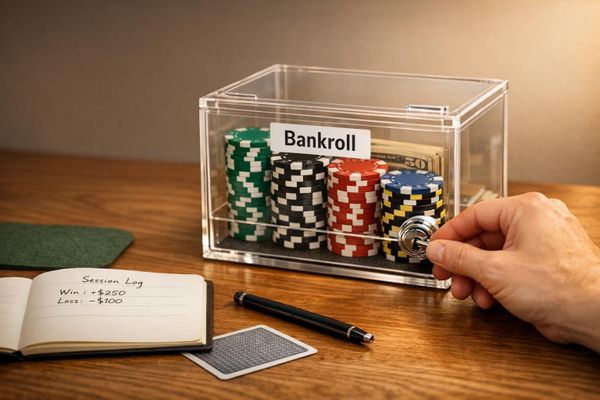
Check Your Bankroll and Set Spending Limits
Before diving into a session, take a moment to assess your Pokerbase bankroll. This should be entirely separate from essential expenses like rent or groceries. Keeping your poker money distinct helps you avoid impulsive, emotionally charged decisions.
How much you need depends on your game type. For cash games, aim for 20–40 buy-ins, while multi-table tournaments require 50–100 buy-ins due to higher variance. Stick to this rule of thumb: never risk more than 1%–2% of your total bankroll on a single tournament. Even top players face extended losing streaks, so managing risk is crucial.
Another key step is setting a stop-loss limit. Decide in advance how many rebuys or how much total loss you’re willing to accept in a session. This helps you step away before emotions take over. If your bankroll dips below 50%–75% of what's recommended for your current stakes, consider moving down to lower limits. Writing these limits on paper can make them feel more concrete and easier to follow.
With your financial boundaries in place, it’s time to set your sights on session goals.
Define Your Session Goals
Each session should have one clear, measurable goal. For instance, you might focus on improving your bet sizing on connected boards. While financial goals are helpful for direction, process-oriented goals keep you grounded and focused, even when variance isn’t in your favor.
To make your goals actionable, use implementation intentions. This means specifying when, where, and how you’ll achieve them. For example: “I’ll sit at my desk at 6:00 p.m. and play ten tournaments within my buy-in range”. Tools like the Pokerbase Tournament Calendar can help you plan ahead and mentally prepare for specific start times.
With goals in mind, the next step is to get into the right headspace.
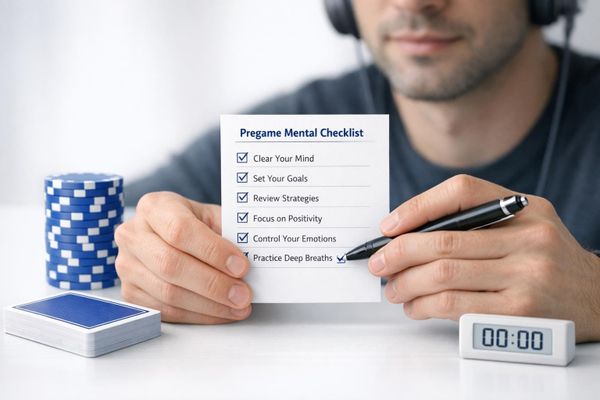
Get Mentally Ready and Remove Distractions
Your mental clarity is just as important as your technical skills. Poker demands focus, and even small distractions can chip away at your performance. Research shows that a winning player with a 5bb/100 hands win rate still loses money in about 40% of individual sessions. Entering the session with a sharp mind is non-negotiable.
Start with a 15-minute warm-up. Begin by reviewing your session goal for two minutes, then spend five to eight minutes on a training drill or puzzle to engage your poker mindset. Rate your emotional state on a scale from 1 to 10. If you’re above a 5, take a moment to address any underlying issues before playing. As ThinkGTO puts it:
The mental game is the multiplier on your technical skill: a player with 80% of the technical knowledge but 100% mental game execution will consistently outperform a player with 100% technical knowledge but 60% mental game execution.
Eliminate distractions by silencing your phone, closing unnecessary browser tabs, and ensuring your environment is comfortable. Have water nearby, adjust your lighting, and set the room temperature to a comfortable level. Finally, visualize how you’d calmly handle losing a big pot. This mental exercise can help you stay composed when faced with real-time challenges.
sbb-itb-94c8472
During Play: In-Session Tracking Checklist
Log Basic Session Information
Launch Pokerbase at the start of your session and input the essential details right away. This includes the start time, location, game type, and stakes. These entries set the groundwork for calculating your hourly rate later.
Start a session timer as soon as you begin. This tool not only tracks how long you play but also integrates with your financial logs to calculate your hourly win rate automatically. Some apps even use GPS to pinpoint the casino location, saving you the hassle of manual entry errors. If you're playing online and multi-tabling, make a note of the tables you're at - Pokerbase can handle tracking for up to 20 sessions simultaneously, giving you a unified view of your profits and losses. Be sure to log every financial move in real time to keep your session records complete and accurate.
Track All Money Movements
Document every buy-in, rebuy, and cash-out as they happen. Waiting until the end of a session risks missing or misremembering transactions. Pokerbase’s ledger-style system makes it easy to log these details directly on your phone, even while you’re still at the table.
For tournament play, take advantage of features like scanning your buy-in receipt. This automatically records the venue, date, and amounts, which is especially helpful for keeping accurate tax records. As Lee Jones from Poker.org wisely points out:
The most sophisticated results tracker will be zero good to you if you don't use it religiously.
Don’t shy away from recording losses alongside wins. Logging tough sessions is just as crucial as celebrating victories. It provides an accurate view of your long-term performance and can even help you process the emotional toll of a difficult session.
Note Opponent Behavior and Your Emotional State
To fully understand your session performance, track both your opponents’ tendencies and your own emotional state. Jot down quick notes about player behaviors as you notice them. For example, note if someone is playing tight or loose, their 3-bet frequency, or whether they fold often to continuation bets. If a weaker player (“fish”) leaves the table or you change seats, make a note of it - these changes can explain fluctuations in your results.
Keep tabs on your own emotions as well. Write down moments of frustration, anxiety, or anger, particularly after bad beats. Blake Eastman, Founder of The Nonverbal Group, emphasizes:
A player's behavior will be a function of their perceived strength or weakness, not necessarily their actual equity.
Recognizing when emotions like tilt start to affect your play can help you determine if it’s time to pause or even end the session early.
Keep Accurate, Honest Records – How Not to Suck at Poker Ep. 9
Hand Recording and Performance Metrics Checklist
Building on your in-session tracking, this checklist focuses on detailed hand analysis and essential performance metrics.
Save and Review Important Hands
Capture key hands immediately using Pokerbase's hand recorder. Waiting too long can mean forgetting critical details like bet sizes, player positions, or the reasoning behind your decisions. Whether it’s a bold bluff, a tricky fold, or a situation where you felt unsure, record the hand as it happens.
The hand replayer lets you revisit these moments later, breaking down each street's action. Include details such as bet amounts, your hole cards, the board texture, and any unique opponent behaviors. This method keeps your hand recording process quick and accurate, even during live games.
Monitor Live Performance Statistics
Keep an eye on your hourly win rate in real time to determine session profitability. Pokerbase syncs your session timer with financial logs to calculate this automatically. For deeper insights, track key stats like VPIP (Voluntarily Put In Pot), PFR (Pre-Flop Raise), and continuation bet percentages, ideally over a sample of 3,000 to 5,000 hands.
Analyze your win rate by position - Button, Cutoff, Middle Position, Early Position, Big Blind, and Small Blind. This breakdown helps identify which positions are most profitable and highlights areas where adjustments could improve your game. Remember, consistent measurement is the first step toward improvement. Alongside these stats, maintain detailed digital records of all financial transactions.
Scan and Store Session Receipts
Take advantage of Pokerbase's document scanner to photograph tournament buy-in receipts, hotel bills, and travel expenses. Its Optical Character Recognition (OCR) feature automatically logs details like venue, date, and amounts, keeping you prepared for tax season. This tool is particularly helpful for tournament players managing multiple entries, rebuys, or add-ons during a series.
After You Play: Post-Session Review Checklist
Your poker session doesn’t end when you cash out. A solid post-session review is key to turning your gameplay data into insights that can refine your strategy and safeguard your bankroll.
Review Your Financial Results
Start by exporting your accounting PDF from Pokerbase. This report gives you a clear snapshot of your total profit or loss, bankroll status, and hourly win rate.
Take a closer look at your results by breaking them down into categories like game type, stakes, and location. This analysis helps you pinpoint trends and identify where you're performing best. If you're part of any staking arrangements, double-check that the app accurately reflects any action bought or sold, ensuring your net earnings align with what you actually took home. Also, take note of whether the session marked any personal milestones, like playing at higher stakes or excelling in a new location - these can reveal areas where you’re growing as a player.
Study Your Statistics and Saved Hands
Now it’s time to dig into the details. Review your logged hands and key stats, such as VPIP and PFR, and compare them to your baseline over a meaningful sample size - ideally 3,000 to 5,000 hands.
Pokerbase’s filtering tools allow you to analyze performance under specific conditions, like certain game types, times of day, or table dynamics. For example, you might learn that you perform better during morning sessions or notice that your win rate drops after certain table changes, like when a weaker player leaves. As professional player Aliaksandr Shylko puts it:
Pokerbase is the best poker bankroll tracker - user-friendly and comprehensive. With its intuitive interface, I can effortlessly monitor my wins, losses, and overall performance.
Write Down Key Lessons Learned
Use the insights you’ve gathered to outline adjustments for your next session. Write down lessons while they’re still fresh. Reflect on whether you stuck to your pre-flop strategy or how well you handled emotional swings. Jot down actionable tweaks, like folding more often to three-bets from tight players in early positions or taking a break after losing two buy-ins.
These notes act as your personal guide for future sessions. Professional player Lee Jones highlights the importance of this step:
Once I put a big loss into my tracking app, it starts the healing process.
Document what strategies worked, what didn’t, and how you’ll improve next time. This habit of reflection turns every session into a stepping stone toward better gameplay.
Conclusion
Keeping track of every detail lays the groundwork for steady improvement in poker. The checklist outlined here offers a straightforward approach: get prepared before you play, log your sessions with precision, and thoroughly review your performance afterward. By sticking to this routine, you'll uncover weaknesses in your game, make better choices about stakes and venues, and approach poker with the mindset of a professional.
Let’s face it - manual tracking can be tedious, prone to mistakes, and often leaves gaps in your data. That’s where an all-in-one solution can streamline the entire process.
Enter Pokerbase. This mobile app brings together session logging, hand tracking, receipt scanning, and advanced analytics in a single platform. Trusted by over 30,000 users, Pokerbase has earned its place as a go-to tool for players of all skill levels, offering insights shaped by top professionals in the game.
Whether you stick with the Free Plan or upgrade to the Pro Plan, consistent tracking and analysis can turn raw data into real gains. Log your sessions as soon as you finish, review your stats regularly, and use those insights to sharpen your strategy. With dedicated tracking, you can transform the ups and downs of poker into opportunities for growth and profit. By following this checklist, you’ll make data-driven decisions part of your routine and set yourself up for long-term success at the table.
FAQs
What should I track if I’m new to session logging?
If you're just starting with session logging, focus on the basics: hands played, total win rate, and the amount won or lost. These metrics give you a solid foundation to understand your performance.
For a more detailed breakdown, consider tracking additional stats like VPIP (Voluntarily Put Money in Pot), PFR (Pre-Flop Raise), 3-bet percentage, C-bet percentage, and fold to C-bet percentage. These numbers can help you analyze your play style and identify areas for improvement.
If you're a tournament player, it's also important to log hours played, winnings, and finish positions. These details provide a clearer picture of your results over time.
To make things easier and more accurate, consider using a poker tracking tool. It can automate much of the process and give you instant access to detailed insights.
How do I set a stop-loss that actually works?
To create an effective stop-loss strategy, start by setting a clear loss limit before you begin your session. This could be a fixed dollar amount or a percentage of your total bankroll. Use tools to track your progress in real time, and commit to sticking to your limit - no matter how tempting it might be to chase losses. Make sure your stop-loss is tailored to your bankroll size and the volatility of the game you're playing, so it fits your personal play style and goals.
How many hands do I need before trusting my stats?
You should aim to gather 20,000 to 30,000 hands before fully trusting your poker stats. With a sample size this large, the data becomes more dependable and less influenced by short-term swings, giving you a solid base for accurate analysis.